An independent analysis layer over the official UAP record.
Declassified UAP documents, videos and audio are parsed into a structured, queryable dataset. Reported statements are kept separate from derived analysis, every field cites its source, and the dataset is appended as each release is published. Cases are not reclassified: each is included because the releasing agency recorded it as unresolved.
New here? Start with how to read this archive — what the dataset is, what it can support, and what to treat as provisional.
- Incidents
- 212
- Documents
- 122
- Videos
- 77
- Audio
- 8
- Agencies
- 7
- Span (yr)
- 81
- Officially unresolved
- 91%
- Median release lag
- 72 yr
Composition and scope
122 documents (4,277 pages), 77 videos and 8 audio recordings from 7 agencies, spanning 1944–2025.
Each document is parsed into one or more incident records with typed fields (date, location, sensor, object descriptors, redaction, resolution status).
Inclusion criterion: every case appears in an official UAP release and is recorded by the releasing agency as unresolved. This dataset does not reclassify those determinations.
Automated image and language analysis is labeled as such and treated as hypothesis, not finding. Reported text is preserved verbatim alongside the derived record.
Record density by decade reflects reporting programs, not sighting frequency
Incident records per decade. The mid-period minimum coincides with the interval between the closure of Project Blue Book (1969) and the establishment of AARO (2022) — periods without a standing collection program.
By occurrence decade the interval declines monotonically: 1940s records released after ~78 years; 2020s records after ~3.5. The temporal distribution is therefore a measure of disclosure activity.
Reported object shapes exceed what the imagery resolves
describe a round / orb / disc shape.
show an unresolved point; 22% resolve a disc/orb. Most targets subtend only a few pixels.
Aggregate measure across the corpus. Reported shape is derived from witness/operator description; resolvable shape is limited by sensor resolution and range. The two diverge.
Apparent shape of a tracked object varies within a single clip
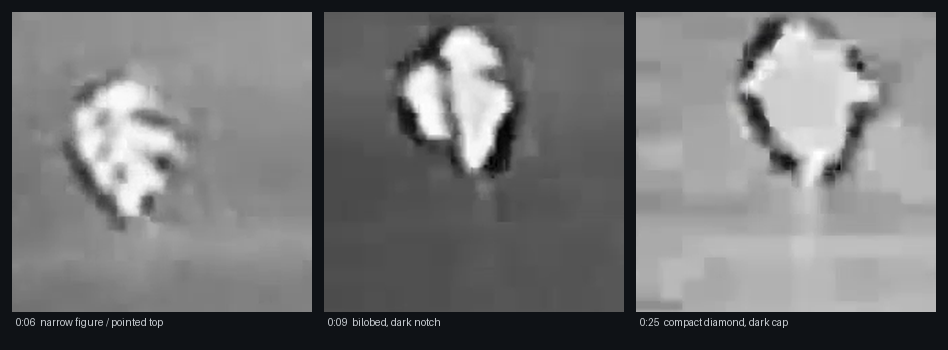
In the clip shown, a single tracked object presents three distinct silhouettes within seconds. A rigid spherical body would present a constant outline at all aspects; a varying outline is consistent with rotation or changing aspect angle. Reported shape is therefore aspect-dependent and unreliable as an identity attribute. Some apparent structure at this resolution is also sensor artifact.
Attributes that recur across the unresolved record
Across 81 years and 7 agencies, the unresolved imagery recurrently shows compact thermal objects without a visible airframe or exhaust signature, frequently persistent and tracked through maneuvers. A subset of clips visually resembles conventional objects (vessels, turbines, sensor blooms); these were not resolved by the releasing agencies and are not reclassified here. Characteristics are reported in aggregate; no determination is made on individual cases.
Orange orbs launching red orbs — Western US, dusk, multi-team observation
Three independent two-person federal law enforcement teams (USPER1–USPER6) observed orange orbs that emitted or launched smaller red orbs in groups of two to four, over at least five separate events during dusk hours across two days. The orange 'mother' orb was visible for only one to two seconds per event before disappearing; the red sub-orbs subsequently moved primarily along horizontal paths, though some moved upward at an angle or swooped downward. The teams observed from varying locations and vantage points, and it is uncertain whether a single or multiple orange mother orbs were involved.
Record and source →Provenance and constraints
- Official resolution status is preserved; cases are not reclassified.
- Reported statements are stored verbatim, separate from derived analysis.
- Confidence scores measure source legibility (OCR/redaction), not credibility.
- Automated image/text analysis is labeled and verified by inspection before use.
- Redaction is quantified from FOIA markers and blacked-out content.
- The dataset is versioned and appended per release.